
Bal Folk is a form of social folk dancing that brings together live music, movement, and community. Rooted in traditional dances from Western Europe and practiced today in both rural and urban settings, Bal Folk events are designed to be welcoming, participatory, and shared. These workshops offer an introduction to the music, dances, and traditions that make Bal Folk both accessible and deeply social.
Could you explain what Bal Folk is for someone who has never heard of it before?
Bal Folk is inclusive social folk dancing from Western Europe. Most of the dances we do are rooted in old rural dances that were done in villages across France over the last few hundred years. These days, people dance the living modern evolution of these traditions all across Europe, at festivals, in urban dance halls, country barns, village squares and living rooms, in groups of 20-2000 people! In a typical evening of Bal Folk, you’ll come across a variety of types of dances: common partner dances that may look familiar, like the waltz, schottishe, polka, or mazurka; the old rural French dances like bourrées and rondeaux, which are sometimes danced with a partner or in a group; Breton dances, that are usually danced in snakey chains without a partner; and other common ‘mixer’ dances where you change partner. The music is almost always live music and usually performed on fiddles, accordions, hurdy gurdies, bagpipes and more.
What can participants expect to learn from the music and dance workshops and how might learning the music first enhance the dance workshop that follows?
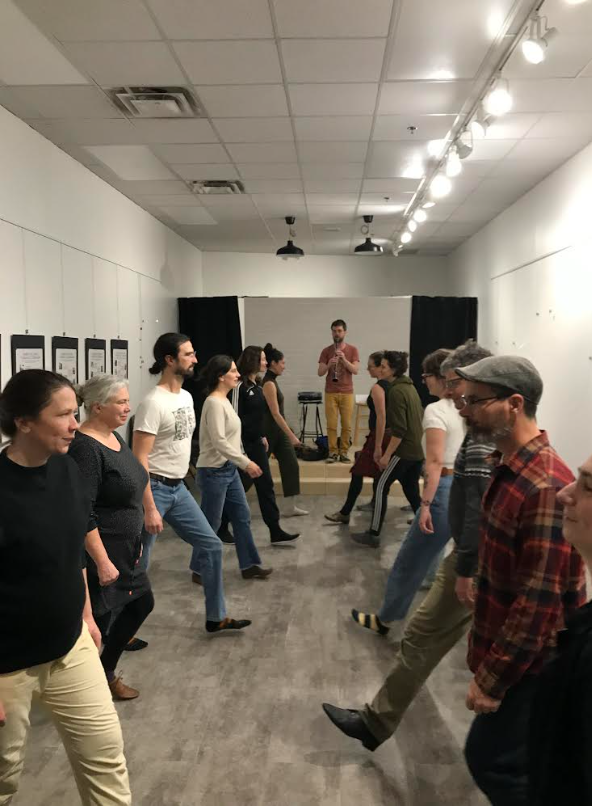
In the music workshops, participants will learn melodies and rhythms associated with the different dance types. They will learn what musical characteristics set apart different tune/dance types. In the dance workshops, participants will learn the basic steps and framework for each dance, plus some variations and tips for improvising within the style. Musicians who participate in both workshops are invited to play for the dancers in the dance workshop to see how the music fits with the dance.
How does each session focus on a different dance style or tradition?
Normally at a Bal Folk event there’ll be a bunch of different dances all evening, but for these workshops we are focusing on just one or two each time. An example is the Bourrée in 3 from Auvergne; on the Feb 26th session we’ll only be focusing on music for Bourrées in 3 followed by instruction on how to dance this particular dance, so people can immerse themselves in the spirit of each different style.
Are these workshops good for beginners to Bal Folk or even just dance in general? What can people expect at their first workshop?
These workshops are open to beginners, as well as people who have attended previous Bal Folk events. The dances have a basic framework that is quite accessible to new dancers, while having depth in variations and possibility to improvise that leaves room to grow. People attending for the first time can expect to meet new people and move around to fun live music in a cozy space!
There is a community and social aspect to Bal Folk, can you go more into depth about that?
Bal Folk events are about dancing with your community, creating your community, celebrating in community! … You don’t need to arrive with a partner – you’re encouraged to meet and dance with new people. The music is social as well – most Bal Folk events end with a community Bal Folk tune jam after the programmed bands have finished their sets. Anyone is welcome to bring their instrument and play these melodies together. We also find it important to emphasize that while some of the dances traditionally had gendered roles, at our events, none of the dance roles are gendered. Everyone is encouraged to try leading and following.
What else are you working on?
In addition to these workshops we are planning a Spring Bal on May 2nd, and a Fall Bal Oct 3rd (and a Winter Bal tbd). These events will include all the dances from the workshops. More info will be updated at emilynandjohn.com/guelph
Sign up here to participate in one of the upcoming workshops (Jan 29th, Feb 5th, Feb 26th, and March 5th).