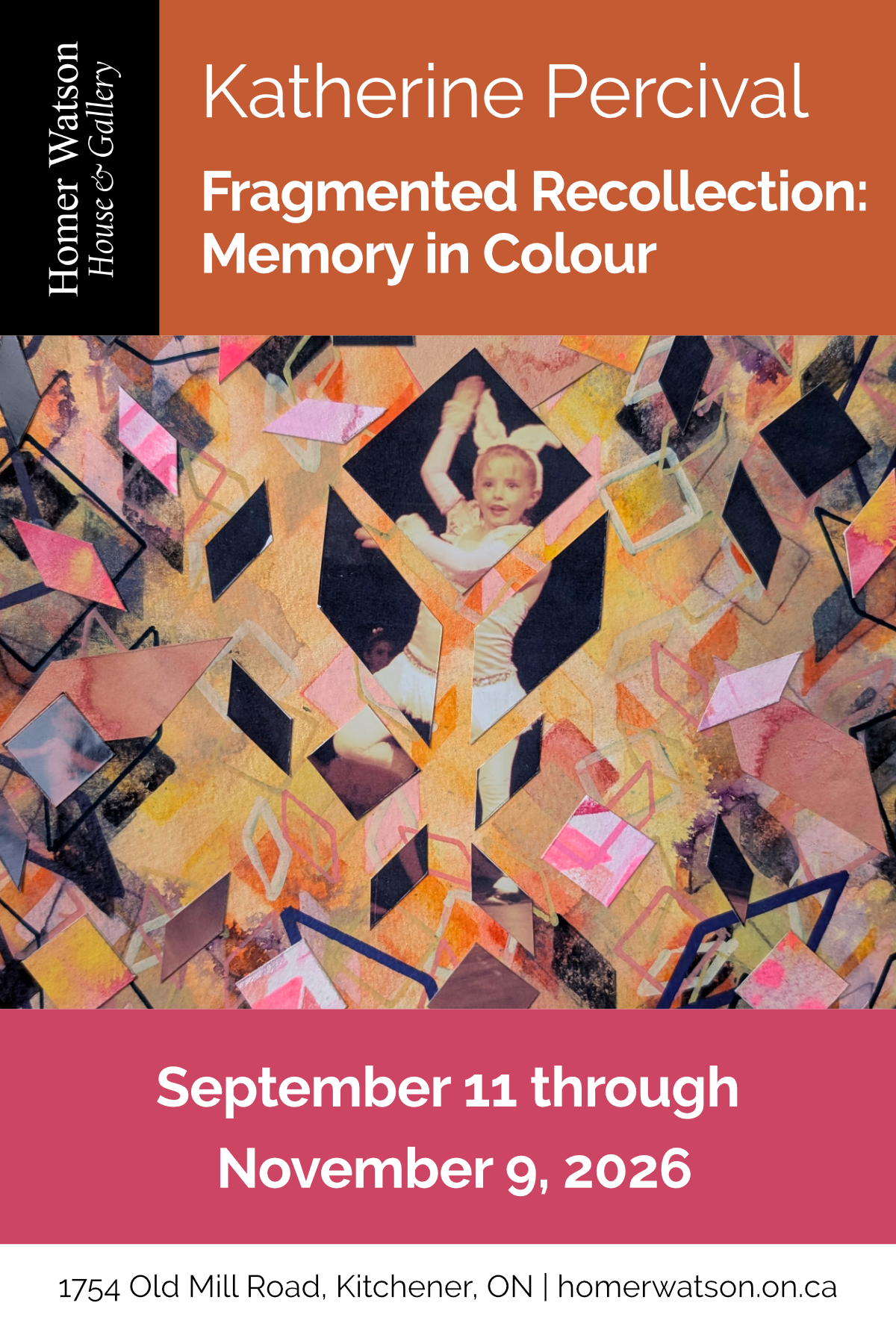

On September 11th, 2026 local Guelph artist, K. Percival’s solo Exhibition at the Homer Watson House and Gallery in Kitchener opened. Fragmented Recollections: Memory in Colour explores the instability of memory through colour, photography, and mixed media. Read along to learn more about this artist’s new body of work.
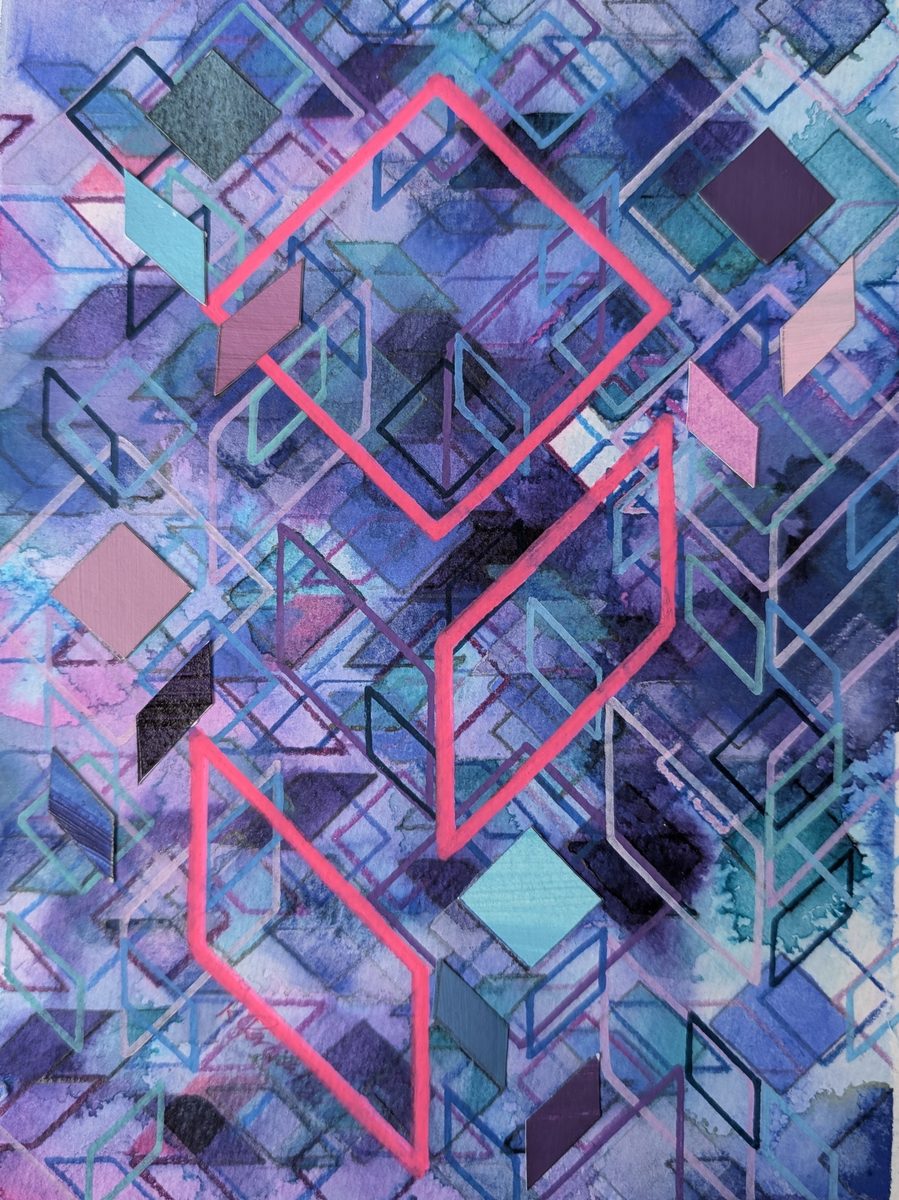
The cube is a consistent motif in your work, however, in Fragmented Recollections, you seem to be using it in a more specific way. Can you share anything about this change?
The show was built around memory, its instability, and how it can become distorted or changed over time. I knew I wanted to use the colours of my past, inspired by family photographs and the emotions and memories that came up while researching them. But after creating a few early works, I felt that something was missing. The nostalgic colour palettes felt accurate to the photographs, but they weren’t capturing the feeling of memory itself.
I tried different ways of physically incorporating the photographs into the paintings. I used objects and figures to define the shapes that were added or removed, but none of these approaches felt quite right. Eventually, I started cutting the photographs using the cube motif that has become a consistent part of my work.
In the paintings, I often think of the cube as a three-dimensional pixel. By using the cubes to cut apart and reconstruct the photographs, I could physically distort and disrupt the images. Sometimes a piece of the photograph becomes a cube within the painting, while in other works, cubes are removed from the photograph entirely. This gave the cube a more specific role in the series. It became a physical representation of the way our memories are constantly being changed, altered, and reconstructed in our minds.
You recently curated a group show at the Blyth Festival Art Gallery, Colour Is…, with colour being the key theme. Your work also utilizes colour significantly, but it seems to be used to represent things more emotionally in this show. What can you say about that?
During my research on memory, I learned that emotional experiences can make certain details of our memories stronger. I wanted to play with that idea in the exhibition by using colour to speak for the emotions connected to each memory, rather than simply trying to recreate what something looked like.
For the paintings connected to my grandmother, I used a very distinct matte black paint that absorbs light. I chose it to represent the void that was left as her memory disappeared with the progression of her dementia. The black isn’t just a colour in these works; it helps communicate the feeling of loss and absence.
In the works connected to my childhood, I used colours that feel nostalgic to the 1990s. These colours aren’t necessarily exact recreations of what I remember. Instead, they speak to the feeling of that time in my life: innocence and childhood, but also the real emotions and experiences I was going through.
Not everything about childhood was easy or simple. Some moments of innocence contain mess or disorder, while moments of joy can also hold underlying feelings of pain or confusion. I wanted the colour to acknowledge those different experiences rather than presenting childhood as simply happy or nostalgic. In that way, the colour speaks to the full emotional experience of the memory in a way that the photograph alone could never express.
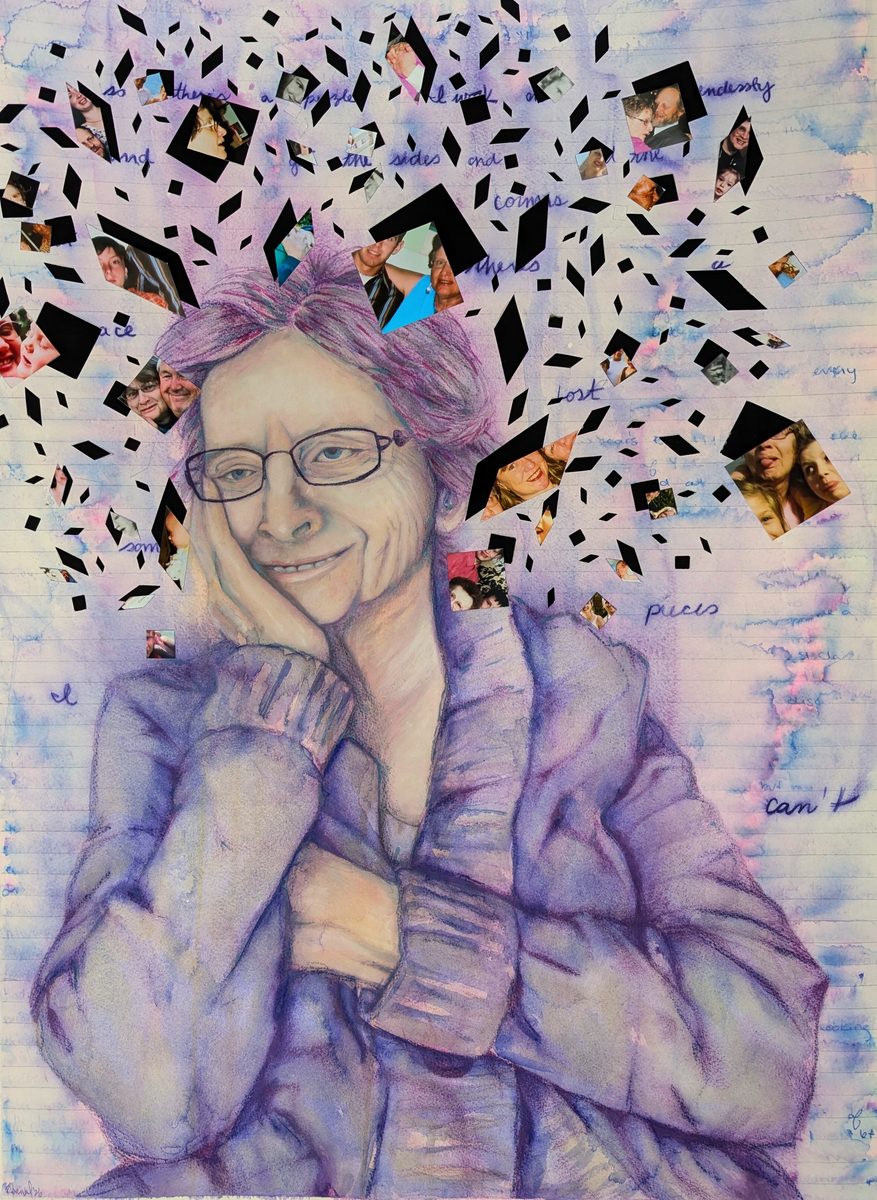
Mixed media feels like it aligns with the layered and fragmented quality of the work in this exhibition, especially with the photographic elements. What draws you to mixed media in the context of this exhibition?
Mixed media interests me in general because I am endlessly curious about how different materials react, repel, and combine with each other. I am always experimenting to see what new colours, textures, and forms can be created when different materials come together.
For this exhibition, using mixed materials felt like a natural extension of the ideas I was exploring about memory. Like materials, memories can change and evolve depending on what they interact with. A pencil crayon can resist watercolour and remain visible beneath it, much like an underlying emotion can remain beneath the facts of a memory. Ink can wash away almost completely, leaving very little evidence that it was ever there, while acrylic creates a more permanent and recognizable layer.
I liked that the materials could do more than create the visual surface of the work. Their physical qualities became another way for me to explore how memories can overlap, change, disappear, or remain with us.
Your work toes the line between recognition and abstraction. What draws you to this in between place and how does it reflect the instability of memory as a core theme of the exhibition?
Memory naturally becomes less consistent over time. Even without a memory disorder, our ability to recall things can change, and the way we remember something can shift over time. As one piece of research puts it, “The way people remember and recall things leads to natural (and non-deliberate) inconsistencies.”
For me, the space between recognition and abstraction reflects that uncertainty. The images are recognizable enough that I can identify the memory I am working from, but they are also fragmented enough to make me question how much of what I am remembering is actually true. I don’t want to present my memories as complete or completely reliable when I know they aren’t.
This is why representing the emotions connected to those memories through colour was so important to me. The details of a memory may change or become unclear, but the feeling I experienced is still real. Colour became a way of holding onto that emotional truth, even when the facts of the memory are less certain.
What surprised you while developing this body of work and where do you see your artistic practice going after this exhibition?
The most surprising element of developing this body of work was how much I ended up using scrapbooking techniques and tools. I have always thought of the women on the maternal side of my family as the memory keepers because of our long-standing family tradition of scrapbooking. My grandmother, aunt, and mother have all scrapbooked vacations, weddings, dance recitals, family milestones, and celebrations.
I even have several scrapbooks of my own, including ones about my marriage, my childhood and family, and a high school trip to Europe. But making this work made me realize that scrapbooking often focuses on the moments we want to celebrate and preserve. It leaves out the quieter moments, the difficult moments, and the experiences that aren’t necessarily happy or worth putting into a traditional scrapbook, even though they are still an important part of being human.
I realized that this body of work had become my version of my family’s long tradition of scrapbooking. The difference is that I am also preserving the moments that I believe deserve the same attention as the celebrations. I think that realization will continue to influence my practice. I am interested in continuing to explore how we preserve memories, what we choose to remember, and what gets left out of the story.
K. Percival is a Guelph-based artist and educator working in mixed media. Her practice uses a recurring cube motif to explore the relationship between chaos and order, emotion and logic, serving as a foundation for material and colour experimentation.
Her work engages with themes of memory, including its loss, recovery, and shifting forms. Drawing on the use of colour and light in Impressionism and the repetition of form demonstrated by Josef Albers, Percival investigates how colour carries historical and cultural meaning, using it as a language to communicate complex human experience and personal nostalgia.
You can learn more about K. Percival at their website and Instagram.
Fragmented Recollections will be on view at the Homer Watson House and Gallery in Kitchener until November 9th, 2026.