
Written by exhibition curator Lisa Fedak.
Guelph Arts Council (GAC) began in the mid-late 1970s. Around the same time, I saw an unusual exhibition at my local public art gallery as part of my high school art class. Beside each piece in the group show was a breakdown of what went into making it, i.e. cost of materials, hours to create, years of training, etc. This idea of foregrounding some of the challenges that lie behind creating art is part of what I wanted to accomplish with this exhibition.
Before 2000, a visual artists’ reputation / career was largely built with printed catalogues, reviews or feature articles in the local papers and eventually a mention in regional, national or international press. It was the same for musicians. Singers and songwriters built careers by performing in as many venues as possible and later by selling (vinyl) albums or cassette tapes independent of major labels. Having a song chart on the radio or their music video appear on Much Music could mean financial rewards that have radically changed since that time.
Today an arts practice involves navigating an ever changing digital environment with regular efforts given to maintaining an internet presence and promoting new work on social media or, at the very least, a professional looking website. Generally speaking, there is an unclear pathway towards generating income. Creative people use various strategies to make a living and generate a sense of security. Part-time employment, teaching, running an adjacent business (like picture framing) or working in arts administration can work.
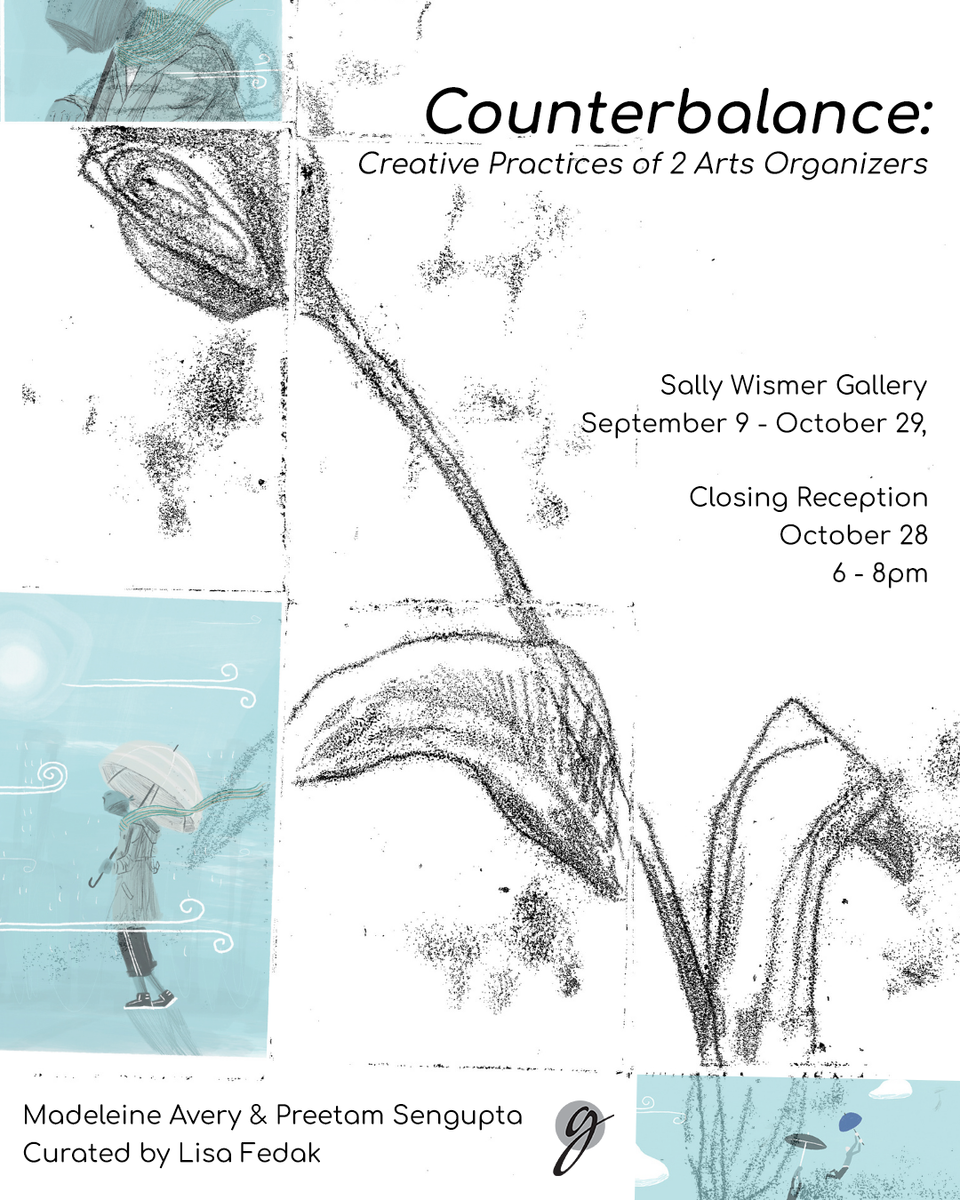
This exhibition looks at the push and pull of a creative practice for two GAC employees: Preetam Sengupta is an established singer / songwriter and Madeleine Avery is a developing printmaker / painter. The opportunity to put their work together in this pilot curatorial initiative allows for a discussion of their creative work-life balance. Through interviews, Avery and then Sengupta revealed the challenges and rewards of balancing necessity, creativity, the impulse to nurture and support, connection with an audience and time for self-reflection.
GAC is made up of members who identify their work as belonging to the sectors of craft, dance, design, literary, media, multidisciplinary, music, performance art, theatre and/or visual art. Sengupta and Avery work hard to help their many members realize their creative dreams, and they are both well-suited for these roles.
Helping a non-tech-savvy artist create their profile on the GAC’s online member portal or encouraging an emerging artist to realize their first exhibition is a very rewarding part of the job. For 17 years, Sengupta has supported musicians with the business side of making music through his company called Letting Artists Make Art. Being of the generation where social media has become second nature, Avery is able to deal with much of the promotional side of member events and GAC programs. They complement one another at work. One likes the fact that the job is never the same day to day and the other is more suited to carrying on with daily routines, but both find meeting deadlines rewarding. Sengupta manages the nuts and bolts of a member driven organization while Avery looks after the majority of the website updates, social media posts, the newsletter, notifications, etc. They both supervise, train and support temporary student-workers who gain valuable experience joining the duo for short periods of time as grants and funding allow.
Finding time for their songwriting / artmaking is a challenge. They’ve got demanding roles at GAC which take a certain amount of creative energy to do well. Sometimes this work requires long hours preparing for large events like Art on the Street or the upcoming GRETAs (Guelph Recognition of Excellence in The Arts). For both of them, having a part-time job or a side hustle on top of their arts administration work is necessary; but the role is flexible enough to accommodate special interests such as studio visits at the University of Guelph (UofG) or perhaps a trip to see a theatre performance in Stratford or Blyth. They are supportive co-workers at different stages of their careers with backgrounds in different artistic disciplines. What their artwork has in common is a gentleness, a storytelling / journaling aspect and a playful vibe. Pairing Sengupta’s handwritten lyrics with Avery’s thoughtful compositional explorations mirrors the way they each support the other in their working relationship – different yet copacetic.
Sengupta fell into his songwriting career when he took on the challenge of writing his own material as part of the Stephen Lewis foundation A Dare to Remember fundraiser in October, 2010. That was a spark. By April 2011, he held a release party for his first album, Hopefull. Two years later, he performed at Hillside. A medical
issue delayed the release of his second album (2017), aptly titled Patience, after which Sengupta continued writing songs and began speaking to groups about resilience. He was interviewed about this on CBC’s Here and Now program as Song of the Week Artist.
Working at GAC allowed him to continue touring and give primary attention to his musical career. The disruption of the pandemic saw Sengupta take on the position of Acting Director for a few months in 2022 eventually returning to the Director position in 2024. His background in business, ability to respond to the moment and sheer hard work have brought the organization to the point where it’s out of survival mode and now “able to have the conversation about dreams.”
Avery started out studying history, then art history, then discovered printmaking in the studio program at UofG. Her introduction to GAC was through an experiential learning course in the winter of 2022 as we were coming out of the pandemic. Following graduation, she got a summer position which by chance got extended. She’s unsure what role her own artmaking will play in terms of career as it’s not her dream to be a full-time artist, but she clearly enjoys creating beauty in her home and continues to make work in fits and starts as limited space at home allows.
Sengupta has taken great pleasure watching Avery grow into the position of Manager of Programs and Communication as he’s moved into the role of Manager
of Operations / Acting Executive Director. They were both somewhat reluctant to showcase their artwork, but I’ve seen a quiet energy bubbling under the surface. Willing to step up and work towards a deadline seems to have generated a sense of adventure – if only to support each other in their art.
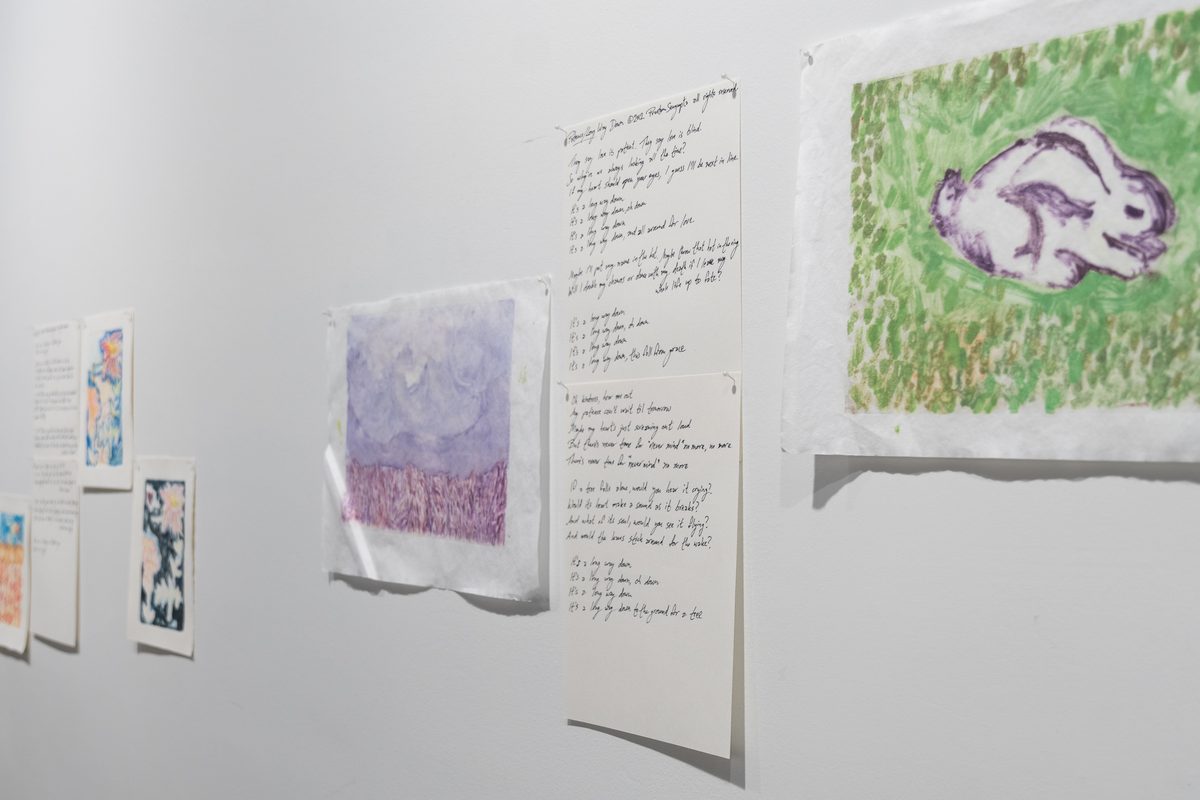
I asked Avery and Sengupta to bring their artwork to work and to create something new for the exhibition. Looking through some of her previous work and the deadline of the upcoming exhibition has been a motivating spark for Avery. Printmaking, specifically monotypes, provide an element of surprise once the image is pulled off the plate and the image is reversed. Experimenting with different types of paper and allowing the ghost images from earlier pulls to build up underneath allows Avery to explore the relationship of her anecdotal imagery to the edges of both the plate and the paper. In my interview with Avery, we decided that the works on paper would remain unframed and simply be pinned to the walls. This gives us the freedom to amplify her compositional playfulness.
The lyrics of Sengupta’s songs are vignettes of love. I feel like I can relate to the story, understand it emotionally and imagine the characters finding their way through complex contemporary scenarios. An idea we developed during my interview with him was to pair his handwritten lyrics with Avery’s works on paper. I envision the prints and lyrics floating across the walls like musical notes on an invisible musical staff.
Sengupta also finds deadlines helpful. He enjoys performing, building trust with an audience, telling stories and responding to the moment. He has very generously agreed to do some songwriting during the exhibition – improvising in response to Avery’s work. We talked about ad hoc, impromptu audience moments which could occur throughout the exhibition culminating in a performance at the closing event.
Sengupta asked Avery to share a book of post-it note sketches during her interview with me. She had taken down a couple dozen small notes and put them in an exercise book to keep safe while she helped her partner move into a new home. The fact that Sengupta and Avery shared this collection of light-hearted domestic
notes led to a plan to project these onto the ‘brick’ wall behind the stage.
This exhibition is an opportunity for Sengupta and Avery to give some attention to their own art practices. Space for making art can get lost when you have important responsibilities supporting other artists in your community. Add to that the regular demands of life. Giving these two arts organizers a limited timeline and the responsibility to create something new is a way to momentarily switch focus and get art off of the back burner. The goal is to play and explore, not worry about creating anything too polished or even finished. I sense an excitement in giving themselves permission to counterbalance the attention both Preetam Sengupta and Madeleine Avery give to their roles as arts organizers.
Lisa Fedak
Guelph, Ontario
September, 2026
With gratitude to Madeleine Avery, Preetam Sengupta, the Sally Wismer Gallery, Guelph Arts Council membership, the community of artists who reside here and the Mac Sween family of editors.