Written by K. Percival
When I first heard about Counterbalance: Creative Practices of 2 Arts Organizers, I was immediately intrigued. As a former employee of the Guelph Arts Council (GAC) and other galleries and arts organizations, I know how challenging it can be to maintain an independent artistic practice while working in a field devoted to creativity. The time, mental energy and emotional capacity required to make your own work doesn’t always fit around the demands of supporting others.
When I spoke with Lisa Fedak, the multidisciplinary installation artist and curator behind Counterbalance, I was struck by her appreciation for Madeleine Avery and Preetam Sengupta, the two artists and arts administrators featured in the exhibition. For Lisa, the project is about recognizing the people who help make the Guelph arts community thrive. But the story begins thirty years ago.
In 1995, Lisa was part of the InstallArt Collective, a group of artists who created Niche, a site-specific exhibition throughout downtown Guelph. Twenty-five artists found their niche within the city, creating installations, interventions and performances in locations beyond traditional gallery walls.
The project required artists to collaborate with store owners, organizations and city staff, while audiences followed a self-guided map to discover the artworks. A printed catalogue and VHS documentary also helped preserve the exhibition.
Making Niche happen required more than artistic ideas. It needed funding, coordination and community support. Sally Wismer, the Guelph Arts Council’s director at the time, provided a letter of support that helped the collective approach other funders. The project received support from the Ontario Arts Council, Canada Council for the Arts, Downtown Board of Management and the City of Guelph. This funding allowed the artists to be compensated and the exhibition to be documented.
It was an early example of how an arts organization can help turn an idea into reality.
Thirty years later, after raising children, teaching, making pottery and navigating the pandemic, Lisa returned to the Guelph Arts Council seeking guidance as she re-entered the local arts community. Once again, she found encouragement, knowledge and support.
That history is central to Counterbalance. The exhibition is not simply a showcase of two artists who happen to work in arts administration. It is also Lisa’s way of recognizing the people and organizations that supported her at the beginning of her career and welcomed her back decades later.
When the Guelph Arts Council issued an open call for a curator to develop a pilot exhibition featuring two artists, Lisa saw an opportunity. She selected Avery, a developing printmaker and painter, and Sengupta, an established singer-songwriter. Though their practices differ, both navigate the challenge of making time for creativity alongside the demands of work and daily life.
Sengupta balances his career as a singer-songwriter with the demands of leading GAC, while Avery continues to pursue her interest in printmaking and painting alongside her role in programs and communications. Their complementary skills help the organization support artists across Guelph’s diverse creative community. Yet, as Lisa recognized, the time and energy spent helping others bring their creative ideas to life can make it difficult to prioritize their own. Counterbalance offers both artists an opportunity to return to their practices, experiment with new ideas and make space for creativity outside their day-to-day responsibilities.
Lisa’s interest in revealing the labour behind art began long before Counterbalance. As a high school student, she visited a public art gallery exhibition where information accompanied each artwork, outlining details such as material costs, hours spent creating and years of training. The experience stayed with her, shaping her interest in helping audiences understand what goes into making art.
For Lisa, Counterbalance offered an opportunity to bring that reality into the gallery. She asked Avery and Sengupta to bring existing work to the office and create something new for the exhibition. The limited timeline was intentional. Rather than expecting polished or finished work, Lisa wanted them to play, experiment and explore.
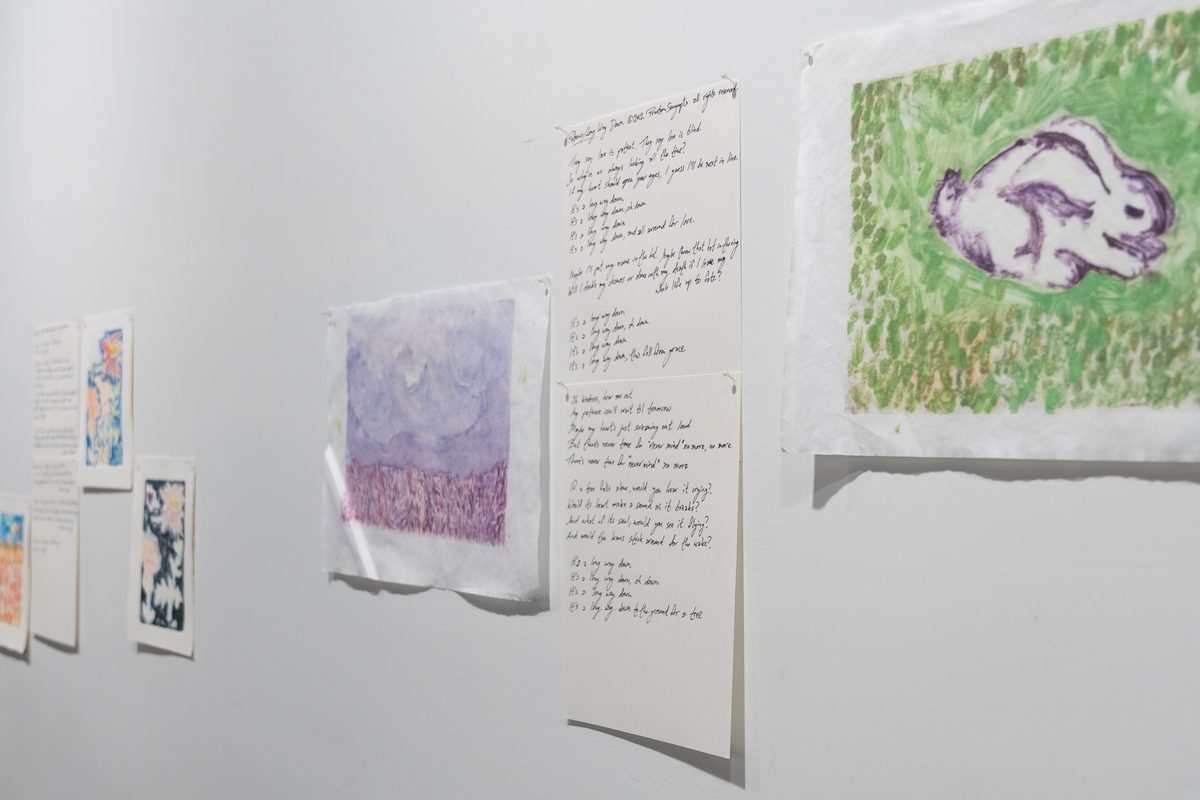
For Avery, the deadline provided a motivating reason to return to printmaking. Working with monotypes, she experimented with different papers and the ghost images left behind by earlier prints. The resulting works explore composition, imagery and the relationship between the edges of the printing plate and the paper. Leaving the works unframed and pinning them directly to the gallery walls further emphasizes their compositional playfulness.
Sengupta’s handwritten song lyrics offer another kind of intimacy. His songs tell stories of love, inviting audiences to imagine characters navigating complex contemporary relationships. Lisa paired the lyrics with Avery’s prints, envisioning them floating across the walls like musical notes on an invisible staff.
The pairing creates a conversation between two distinct artistic practices while reflecting the complementary relationship the artists share at work.
Sengupta enjoys performing, building trust with an audience and responding to the moment. For Counterbalance, he agreed to experiment with songwriting in response to Avery’s work, opening the possibility of spontaneous musical encounters throughout the exhibition. He will also perform at the exhibition’s closing event on October 28, from 6 to 8 p.m.
Another unexpected connection emerged when Sengupta asked Avery to share a book of small sketches she had made on Post-it notes while helping her partner move. These light-hearted observations of everyday life inspired plans to project the sketches onto the brick wall behind the stage.
These details reveal the spirit of the exhibition. Rather than presenting art as a finished product, Counterbalance makes room for experimentation, collaboration and the unexpected directions that emerge when artists give themselves permission to play.
Neither Avery nor Sengupta was particularly eager to showcase their own artwork. Yet, as Lisa brought their practices together, she sensed a quiet energy bubbling beneath the surface. Working toward a deadline and supporting one another seemed to generate a sense of adventure.
That willingness to step forward is an important part of the story. Not every artist is striving to make art their sole source of income, and not every creative practice follows a clear career trajectory. Sometimes, making room for creativity means finding the time, space and encouragement to return to something that matters.
Lisa describes Counterbalance as a heartfelt thank you to the people and organization who supported her thirty years ago and continue to support her today. By curating this exhibition, she has found a way to put that gratitude into action, living out her belief that she should “put my money where my mouth is” and directing attention toward the people who help sustain Guelph’s creative community.
As someone who has worked in arts organizations, I understand how easily the responsibilities of supporting others can take priority over your own practice. There is always another deadline, another opportunity to organize or another artist who needs support.
What makes Counterbalance meaningful is that it doesn’t pretend those demands disappear. Instead, it creates a window of opportunity for Avery and Sengupta to experiment, reconnect with their work and make something for themselves.
Thirty years after receiving support for Niche, Lisa is returning that generosity. The exhibition recognizes not only the creative practices of Madeleine Avery and Preetam Sengupta, but also the often-unseen labour, care and commitment that help a community of artists thrive. It reminds us that supporting the arts means making room for the people behind the work, too.