
Folds in Our Unfolding Trajectories is a sound installation by artist Dave Riedstra, shaped by the unique space of the Guelph Youth Music Centre. Visitors are invited to explore the space and notice how sound responds to their presence and the environment around them. Learn more about Folds in Our Unfolding Trajectories from an interview with the artist.
The work responds to the acoustics and movement happening within the Guelph Youth Music Centre. How did this specific space shape your approach to the work or how did you modify the work for the space?
Folds in Our Unfolding Trajectories developed out of a late 2024 proposal for an experiment in Ed Video’s previous gallery space on York Rd. The idea with that proposal was to learn about the possibilities of using the gallery itself as the sonic material by mounting the sound-making and receiving hardware on the inside of the walls. The proposal was accepted and supported by a GAC microgrant, but shortly afterwards Ed Video relocated to Silence, which meant we had to figure out a new plan.
The GYMC atrium is quite different from the gallery on York Rd: it’s much larger in every dimension, has incredible natural light, and it doesn’t really have any walls that would be suitable for mounting audio hardware within. However, the height and breadth of the space means that I can suspend objects from the ceiling, allowing visitors to really weave their movement through and within the piece, which I am really enthusiastic about and which has shaped my thinking about the work. Much of my work is oriented toward facilitating an awareness of entanglement (for example, a listener hearing a process change along with their own presence and activity), but in the past I’ve generally used smaller sound-making objects tucked away in some corner, waiting potentially to be stumbled on. The atrium space has really allowed me to expand those ideas to a larger and more variegated environment which visitors can spend time in and explore.
This installation responds in real time to the environment around it. Have there been any surprising interactions during testing or setup that change how you think about the piece?
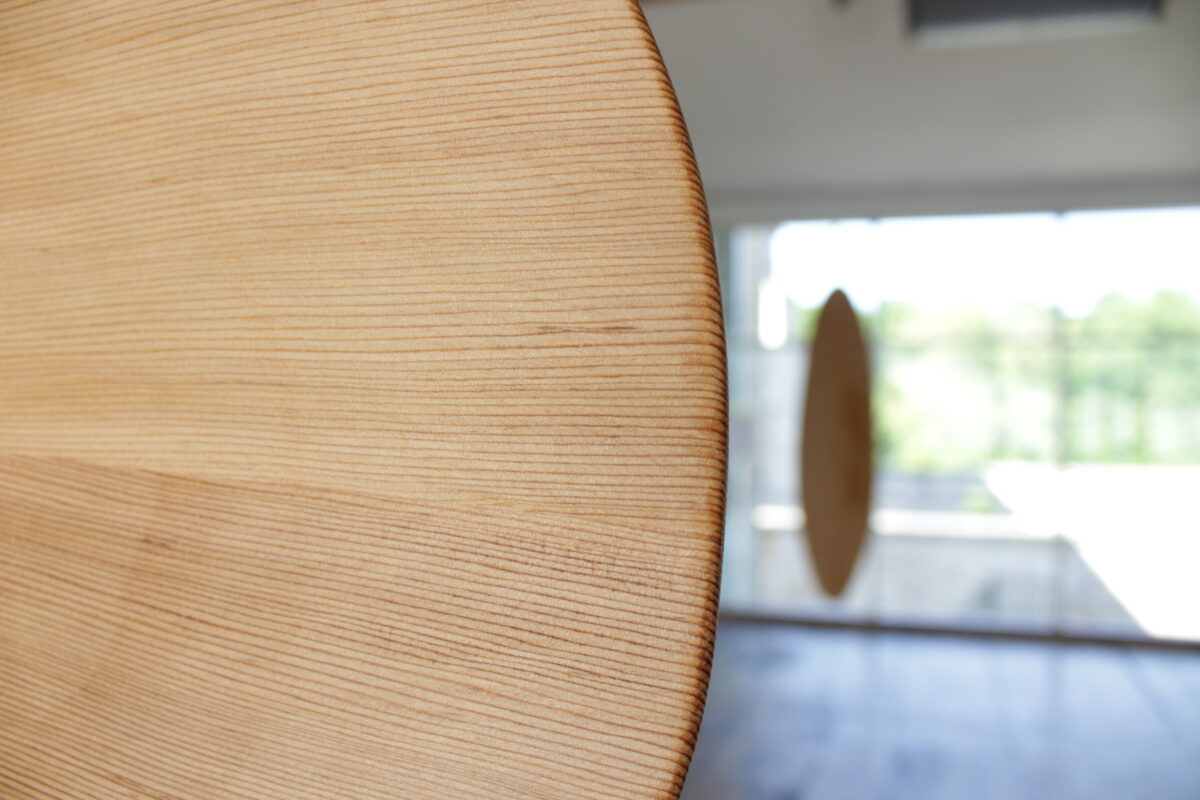
For the hanging objects I decided to use some western red cedar I had left over from a previous project (though I ended up needing much more). This is a lightweight wood which makes it acoustically useful (luthiers sometimes use it in guitars), but what I didn’t expect was how much it would respond to air movements in the space. The pieces gently spin and turn on the air currents and drafts from people moving by and the building’s HVAC, which really changes the direction of sound projection or reception from each particular piece and in turn modulates the unfolding sound. There is also a lot of nearby activity in various planes (acoustic, mechanical, electromagnetic) that interacts with the piece. I’m particularly interested in hearing how it responds to passing trains when it’s set up in its final form.
.How do you balance control and unpredictability when working with these technologies?
With care, hopefully! I think this work really hinges on openness, which drives the piece’s behaviour into unpredictable places and provides a situation for visitors to discover and attune to unfamiliar sensations.But since I also have ideas about the general shape of the experience I want the thing to enable, I direct the parameters of that openness. In the past some artists have bent over backwards to try to remove themselves from their work in order to create something “truly open” or “neutral”, but I don’t think that that’s actually possible, so the task for me is to try to facilitate an experience that generates what I think of as desirable qualities and orientations of openness and unpredictability. I also prefer to think of control as intentional working-with, which means remaining open to the possibilities and limitations presented by the venue, my materials and workspace, and also my time, body, and other resources. As a result, I’m embedded in the piece through my ideas about what I want it to do, and my situation and environment are embedded in it as well in the way that they shape the kind of work I can do on the piece.
.What kind of experience do you hope visitors take away from Folds in Our Unfolding Trajectories?
I definitely have ideas but I’m also wary of overdetermining it. I’ll just say that I hope it provides an opportunity to spend time taking in and exploring relations to sound, movement, situation, and others.
Folds in Our Unfolding Trajectories opens September 27th at the Guelph Youth Music Centre (75 Cardigan St., Guelph, ON) with a reception taking place that same day from 2pm-6pm. The installation will be available to view until October 12th 2025. The exhibition is part of Culture Days, featured by Ed Video Media Arts Centre in collaboration with the Guelph Youth Music Centre.
Learn more about Dave’s work here.